

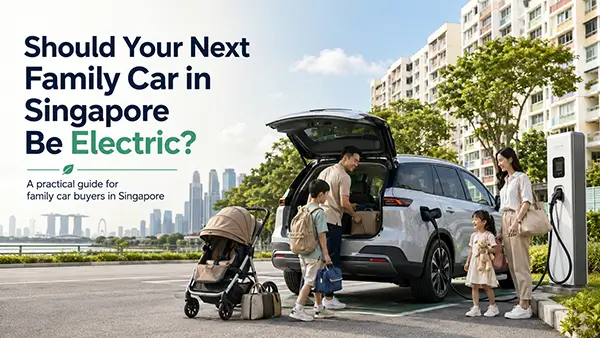
Buying a family car in Singapore is rarely a simple decision.
The car must be comfortable enough for school runs, weekend outings and grocery shopping. It may need space for child seats, elderly parents, sports equipment, luggage or a stroller. It also needs to be affordable over its remaining Certificate of Entitlement period.
Electric vehicles add another set of questions.
Will charging be convenient? Is the advertised range realistic? Will the car still have enough boot space when every seat is occupied? What happens when the family drives to Johor Bahru or Kuala Lumpur? Are the savings from electricity enough to justify the purchase price?
For many Singapore families, an electric vehicle can now be a practical and financially sensible choice. However, the answer depends less on the headline driving range and more on three factors:
- Whether you have reliable access to charging
- Whether the vehicle genuinely fits your family
- Whether the complete ownership cost is competitive
An EV is not automatically the best family car simply because it is newer, quieter or cheaper to charge. It must work with your family’s actual routine.
Electric Cars Are No Longer a Niche Choice in Singapore
Electric vehicle adoption has accelerated considerably.
EVs represented approximately one-third of all new cars registered in Singapore in 2024, compared with 18% in 2023. Between January and August 2025, about half of newly registered cars and taxis were fully electric.
The charging network has expanded alongside this growth. Singapore had approximately 30,500 charging points as of March 2026, halfway towards the Government’s target of 60,000 charging points by 2030. The target consists of 40,000 chargers in public carparks and 20,000 on private premises.
By December 2025, all HDB towns were considered EV-ready and more than 90% of HDB carparks had charging points. The Government also plans to establish at least one fast-charging hub in every HDB town by the end of 2027.
This does not mean charging is equally convenient everywhere. As of March 2026, 139 HDB carparks—around 7% of the total—still did not have chargers because of technical constraints or requests to delay deployment. Residents affected by this can transfer their season parking to a nearby HDB carpark with charging facilities at the same season parking rate.
The infrastructure is therefore increasingly ready, but families should still investigate their own estate rather than relying on national statistics.
Why an EV Can Be a Good Family Car
1. EVs are comfortable in Singapore traffic
Electric motors deliver power smoothly and almost immediately. There are no conventional gear changes, engine vibrations or engine noise during normal driving.
This can make an EV particularly comfortable during:
- Stop-and-go morning traffic
- School drop-offs and pick-ups
- Long waits at immigration checkpoints
- Trips with sleeping children
- Journeys with elderly passengers
- Frequent urban driving
Regenerative braking can also make city driving less tiring once the driver becomes familiar with it. Some models allow the driver to adjust how strongly the car slows when the accelerator is released.
However, families should test the braking behaviour themselves. A strongly configured one-pedal driving mode may feel uncomfortable to passengers when used abruptly.
2. The cabin can be more spacious
An EV does not need a traditional engine, gearbox or transmission tunnel in the same way as a petrol car. This gives manufacturers more flexibility when designing the cabin.
Possible benefits include:
- A flatter rear floor
- More space between the front seats
- Additional storage under the centre console
- A front storage compartment in some models
- A longer wheelbase relative to the car’s overall length
These features can make it easier to carry school bags, groceries and other family items.
Nevertheless, buyers should not assume every EV has excellent space. A thick battery installed under the floor can raise the cabin floor, resulting in a less natural seating position. This is especially noticeable in the third row, where passengers may sit with their knees raised.
The specification sheet cannot tell you whether the seating position is comfortable. Every regular passenger should sit in the car before a purchase is made.
3. Charging can cost much less than petrol
The largest recurring EV saving usually comes from energy rather than servicing.
Public AC charging in Singapore was commonly priced at approximately S$0.58 to S$0.74 per kilowatt-hour in 2026, while the median public charging rate was about S$0.69 per kilowatt-hour. Faster DC charging normally costs more.
For comparison, listed RON95 petrol prices were approximately S$3.36 to S$3.37 per litre on 24 July 2026 before card, membership and station discounts. Fuel prices can change quickly, so these figures should only be treated as a snapshot.
Consider two hypothetical large family cars:
- An electric SUV consuming 20kWh per 100km
- A petrol MPV consuming 9 litres per 100km
At S$0.69 per kWh, the EV would cost approximately S$13.80 per 100km using public charging.
At S$3.36 per litre, the petrol vehicle would cost approximately S$30.24 per 100km before petrol discounts.
Over 15,000km, that works out to approximately:
- EV using public charging: S$2,070
- Petrol vehicle before discounts: S$4,536
A landed-property owner charging at the regulated household electricity tariff could potentially pay less. The household tariff for 1 July to 30 September 2026 was 34.78 cents per kWh including GST. At that tariff, the same EV would use approximately S$1,043 of electricity over 15,000km.
These are simplified energy calculations. Real costs depend on driving style, traffic, air-conditioning, battery charging losses, petrol discounts, charger pricing, parking fees and idle charges.
The important point is that EV energy costs can be substantially lower, but the saving is greatest when the family has access to reasonably priced AC or home charging. A driver who depends heavily on premium fast chargers will save less.
4. Routine maintenance can be simpler
A fully electric car has no engine oil, spark plugs, exhaust system or conventional engine. It generally has fewer moving components and fewer fluids requiring regular replacement than a petrol vehicle.
An EV still requires maintenance for:
- Tyres
- Brakes and brake fluid
- Air-conditioning
- Suspension
- Cabin filters
- Cooling systems
- Windscreen wipers
- Electronic systems
- The 12-volt battery
- The high-voltage battery and related components
Regenerative braking may reduce the use of the friction brakes, but EVs are often heavy and produce strong torque. Poor wheel alignment, aggressive acceleration and incorrect tyre pressure can cause tyres to wear quickly.
Families should therefore compare the dealer’s complete servicing schedule rather than accepting a general claim that an EV is “maintenance-free”.
5. There are still significant EV incentives in 2026
A fully electric car registered from 1 January to 31 December 2026 can receive an EV Early Adoption Incentive equal to 45% of the Additional Registration Fee, capped at S$7,500.
The EEAI will cease from 1 January 2027.
Under the Vehicular Emissions Scheme, qualifying Band A cars receive a rebate of S$22,500 in 2026. Combined EEAI and VES savings can therefore reach up to S$30,000 off the ARF for an electric car registered in 2026. In 2027, the maximum combined benefit will fall to S$20,000 because the EEAI will have ended and the VES rebate will be reduced.
The actual saving depends on the vehicle’s ARF and emissions band. A buyer may not receive the maximum amount simply because the vehicle is electric.
Buyers should ask the dealer to show clearly:
- Open Market Value
- Basic ARF before rebates
- VES rebate
- EEAI rebate
- Net ARF paid
- COE category and COE amount
- Total basic cost
- Dealer margin
- Final selling price
This makes it easier to compare an EV with a hybrid or petrol alternative on the same basis.
6. EVs produce no tailpipe emissions
A fully electric car does not produce exhaust emissions while being driven. LTA describes EVs as the cleanest vehicle option and Singapore is working towards having all vehicles run on cleaner energy by 2040.
Electricity generation still creates emissions, and battery manufacturing has an environmental footprint. An EV should therefore not be viewed as completely emission-free over its entire lifecycle.
However, removing tailpipe emissions remains valuable in a densely populated city, particularly around homes, schools and busy roads.
Reasons an EV May Not Be Right for Your Family Yet
1. Charging convenience can matter more than range
A family does not necessarily need the EV with the biggest battery. It needs a car that can be charged without disrupting the family’s routine.
For an HDB resident, investigate:
- Whether your usual carpark has chargers
- How many charging bays are available
- Which operator manages them
- Their charging speed
- Current price per kWh
- Whether idle fees apply
- How busy the chargers are after work
- Whether chargers are frequently unavailable or faulty
- Whether another nearby carpark provides a backup
Average utilisation of HDB chargers was approximately 20% in May 2026, with higher demand at night. Utilisation was especially high in Tengah, Punggol and Sengkang.
An average figure can hide local congestion. One carpark may have several underused chargers, while another may be busy every evening.
Before buying an EV, visit the carpark on two or three weekdays between approximately 7pm and 11pm. Check whether the chargers are available when your family would realistically need them.
2. A seven-seater is not always a genuine seven-person car
Some vehicles are marketed as seven-seaters but are better described as five-seaters with two emergency seats.
For a large family, check whether the third row can accommodate the intended passengers without requiring the second row to be pushed excessively forward.
Look at:
- Third-row legroom
- Headroom
- Seat cushion height
- Knee position
- Air-conditioning vents
- USB charging ports
- Cupholders
- Window size
- Ease of entry
- Seatbelt placement
- Emergency exit access
The air-conditioning test is particularly important in Singapore. Some large EVs have impressive front cooling but limited airflow to the third row.
Keep the car stationary with all passengers seated and the doors closed. Test how quickly the rear cabin cools after the car has been parked outdoors.
3. Boot space may disappear when all seats are used
A quoted boot capacity often applies only when the third-row seats are folded.
Ask to see the luggage area with every passenger seat raised. Then test it using the items your family regularly carries, such as:
- A full-sized stroller
- School bags
- A wheelchair or walking aid
- Grocery bags
- Sports equipment
- Cabin luggage
- Baby supplies
A front storage compartment can help, but it may not be large enough for bulky family items.
For a family of six or seven that travels together frequently, an electric MPV may be more practical than a three-row electric SUV, even when the SUV looks more attractive.
4. Large and powerful EVs may incur higher road tax
Singapore calculates electric-car road tax according to the vehicle’s maximum motor power. EVs also pay an Additional Flat Component because they do not contribute Fuel Excise Duty when charging.
The Additional Flat Component for an electric car is S$350 every six months, or S$700 per year, on top of the power-based road-tax calculation.
A large dual-motor EV can therefore have significantly higher road tax than a less powerful single-motor model.
Maximum power also affects the COE category. Fully electric cars with a maximum power output of up to 110kW fall under Category A. Electric cars above 110kW fall under Category B.
Many larger electric SUVs and MPVs exceed 110kW. Buyers should not assume that an EV will automatically qualify for Category A simply because it is positioned as a mass-market family car.
Compare the exact motor output, COE category and annual road tax before placing a deposit.
5. Lower running costs do not guarantee lower ownership costs
Electricity may be cheaper than petrol, but energy is only one component of Singapore car ownership.
The complete calculation should include:
- Purchase price
- COE
- Loan interest
- Road tax
- Insurance
- Charging
- Parking
- Servicing
- Tyres
- Warranty coverage
- Expected resale value
- PARF rebate
- Remaining COE value
From the second COE bidding exercise in February 2026, the PARF structure for newly registered cars changed significantly. A car deregistered within its first five years is now eligible for 30% of ARF paid, capped at S$30,000, compared with the previous 75% rate for earlier registrations. The percentage declines further as the car approaches ten years old.
This change affects petrol, hybrid and electric cars, but EV buyers should also understand that emissions rebates reduce the net ARF paid. The PARF rebate is calculated using the net ARF after applicable emissions rebates.
In other words, part of an upfront VES saving may be reflected in a lower PARF rebate later.
The correct comparison is therefore not simply:
EV price minus S$30,000 incentive
It should be:
Total amount paid, less expected resale or deregistration value, plus all financing and operating costs over the intended ownership period
6. Cross-border travel requires more preparation
Most modern EVs have more than enough range for everyday driving within Singapore. The more important question for some families is how the car performs during trips to Malaysia.
Drivers who regularly travel to Johor, Malacca, Kuala Lumpur or further north should consider:
- Real highway range at 100km/h to 110km/h
- Range with six or seven passengers
- Luggage load
- Continuous air-conditioning
- Heavy rain
- Traffic delays at the checkpoints
- Availability of DC fast chargers
- Charging-network apps and payment methods
- Whether the charger supports the car’s connector
- The car’s maximum DC charging rate
- How long it can maintain that charging rate
- Availability of alternative chargers nearby
A car advertised with a long range may still charge slowly. Conversely, a vehicle with a smaller battery but an efficient drivetrain and strong charging performance may complete a road trip more quickly.
Do not compare only the peak charging figure. Ask how long the car takes to charge from 10% to 80%, and review independent charging tests where available.
A family that drives to Malaysia once or twice a year can usually plan around charging stops. A family that travels across the border every week may find a hybrid more convenient unless the route has reliable chargers that fit its normal stopping pattern.
Is EV Safety a Concern for Families?
EV battery fires receive substantial attention because they can be difficult to control once thermal runaway occurs. However, available Singapore data does not suggest EVs catch fire more frequently than conventional vehicles.
LTA reported in September 2024 that EVs accounted for approximately 0.7% of vehicle fires during the preceding three years. It also noted that international studies had found a lower rate of fire occurrence for EVs than for internal-combustion and hybrid vehicles.
Singapore requires EVs to comply with recognised international safety standards. Charging equipment is regulated under the Electric Vehicles Charging Act, while approved charging systems must comply with Singapore’s TR25 charging standard.
Safety should still be evaluated model by model.
For a family car, look beyond the number of airbags. Check:
- Independent crash-test results for the exact model
- Protection for third-row passengers
- Side-curtain airbag coverage
- Child-seat anchorage positions
- Rear-door child locks
- Blind-spot monitoring
- Rear cross-traffic alert
- Automatic emergency braking
- Driver-monitoring systems
- Availability of spare parts
- Local high-voltage repair capability
A model may have an impressive list of driver-assistance features while providing limited crash protection to passengers in the last row. Independent testing is more valuable than the length of the equipment list.
HDB, Condominium or Landed Property: Who Benefits Most?
HDB residents
An EV can work well for an HDB household when the usual carpark has sufficient chargers and the vehicle does not need to be charged every day.
The best candidates are families that:
- Have chargers in their season-parking carpark
- Drive predictable daily distances
- Can leave the car charging for several hours
- Have alternative chargers nearby
- Do not need frequent emergency charging
The weakest candidates are those whose carparks have very few chargers, high evening demand or no convenient alternative.
Condominium residents
Condominium charging depends heavily on the development and its management corporation.
Before purchasing an EV, confirm:
- Number of operational chargers
- Ratio of EVs to chargers
- Charging price
- Access rules
- Visitor and resident priorities
- Idle fees
- Plans to add chargers
- Whether residents may install individual chargers
- How installation and electricity costs are allocated
Do not rely on a sales agent’s statement that the condominium is “EV-ready”. Confirm the situation directly with the managing agent or council.
Landed-property owners
Landed-property owners usually have the strongest case for an EV because the car can be charged at home.
Home charging can provide:
- Lower electricity cost
- Predictable overnight availability
- Less dependence on public chargers
- A full or sufficient charge each morning
- Greater control over the charging schedule
Installation must still be completed using properly approved equipment and qualified professionals. Singapore prohibits unsafe arrangements such as charging an EV through extension cords or ordinary household socket outlets.
EV, Hybrid or Petrol: Which Is Better for Your Family?
Choose a fully electric car when:
- Reliable charging is available at home or near your regular parking location
- Most journeys are within Singapore
- Your daily mileage is predictable
- Lower energy costs are important
- You plan to keep the car long enough to benefit from operating savings
- The chosen model has sufficient real-world space
- Malaysia trips are occasional or can be planned around charging
- The vehicle has strong local warranty and service support
Consider a hybrid when:
- You cannot depend on regular charging
- You frequently travel long distances in Malaysia
- The car is sometimes needed at short notice with little time to charge
- You want lower petrol consumption without changing your refuelling routine
- A suitable electric seven-seater is too expensive or impractical
- You are uncomfortable with current EV resale uncertainty
A conventional hybrid does not need to be plugged in. It can therefore be a useful middle ground for families that want better efficiency without planning their routine around chargers.
From 2026, however, hybrid cars no longer qualify for VES rebates, although they may remain neutral or incur a surcharge depending on their emissions band. Only qualifying EVs receive VES rebates under the revised scheme.
Consider a petrol car when:
- The purchase price is substantially lower
- Annual mileage is low
- The family needs a particular body style unavailable as an EV or hybrid
- The car will be used frequently in places where charging is inconvenient
- Simple, rapid refuelling is a priority
- A trusted and well-supported petrol model offers better total ownership value
Petrol should not automatically be dismissed. In Singapore, depreciation and financing can outweigh energy savings. A competitively priced petrol model may still cost less overall for a low-mileage family.
The Family EV Test-Drive Checklist
Do not test an EV alone. Bring the people and equipment the vehicle is expected to carry.
Seating and access
- Install every child seat the family uses.
- Check whether the remaining seats are accessible.
- Ask adult family members to sit in the third row.
- Test entry while child seats remain installed.
- Confirm that elderly passengers can enter and exit comfortably.
- Check whether powered seats move quickly enough for practical third-row access.
Storage
- Raise every passenger seat.
- Load the stroller, wheelchair or large family items.
- Check whether charging cables take up boot space.
- Look for underfloor storage.
- Confirm whether the tailgate can open in a low carpark.
Comfort
- Test rear air-conditioning in hot weather.
- Listen for tyre and road noise at expressway speeds.
- Check whether the suspension remains comfortable over humps.
- Sit in the rear while someone else drives.
- Test regenerative braking with passengers onboard.
Driving and charging
- Drive the car with a realistic passenger load where possible.
- Check consumption after a mixed urban and expressway route.
- Ask for the usable battery capacity, not only the gross capacity.
- Confirm AC and DC charging speeds.
- Ask whether battery preconditioning is available.
- Find out which charging apps and networks work with the vehicle.
- Confirm whether a charging cable is included.
Ownership
- Obtain the annual road-tax figure in writing.
- Confirm the COE category.
- Request an insurance quotation before ordering.
- Check tyre size, brand and replacement cost.
- Review the battery and vehicle warranty separately.
- Confirm whether the battery warranty has a minimum health guarantee.
- Ask what happens if the battery falls below that level.
- Check the location and capacity of the authorised workshop.
- Ask about parts availability and accident-repair waiting times.
- Request a written breakdown of ARF, VES and EEAI amounts.
Questions to Ask Before Ordering an Electric Family Car
- Can every regular passenger sit comfortably?
- Is there usable boot space with all seats raised?
- Can the car fit the family’s child seats simultaneously?
- Does air-conditioning reach the third row?
- Where will the car be charged most weeks?
- What is the backup plan when the usual charger is occupied?
- What will public charging cost each month?
- Is the vehicle in COE Category A or Category B?
- What is the exact annual road tax?
- What does the battery warranty cover?
- Is battery degradation covered or only complete failure?
- How much will replacement tyres cost?
- What is the expected waiting time for major parts?
- Is the car suitable for the family’s Malaysia travel pattern?
- What is the projected five-year or ten-year ownership cost?
Final Verdict: Should Your Next Family Car Be Electric?
For many Singapore families, the answer is increasingly yes.
An EV can provide a quiet cabin, smooth driving, lower energy expenses and reduced routine maintenance. Singapore’s charging network has grown rapidly, and EV buyers registering a qualifying car in 2026 can still receive significant ARF rebates.
The strongest case exists for a family that has dependable overnight charging, drives regularly and has found an EV that genuinely meets its passenger and luggage needs.
The answer may still be no, or at least not yet, when charging is uncertain, cross-border travel is frequent, or the available electric models require unacceptable compromises in third-row comfort and boot space.
Do not choose an EV purely because it has the longest range, the biggest touchscreen or the largest advertised incentive.
Choose it when:
- The seating works
- The charging routine works
- The complete ownership calculation works
- The vehicle remains practical on your family’s most demanding day
The best electric family car is not necessarily the one that travels furthest on a single charge. It is the one that fits naturally into family life without requiring everyone to plan around the car.
Frequently Asked Questions
Is it practical to own an EV while living in an HDB flat?
Yes, provided your regular carpark or a nearby alternative has sufficient chargers. More than 90% of HDB carparks had charging points by the end of 2025, although availability and demand vary by estate. Check the carpark during the hours when you would normally charge.
How much range does a Singapore family need?
For normal Singapore driving, a very large battery is rarely essential. A realistic range of approximately 300km to 400km can cover several days of driving for many households. Families that frequently drive to Malaysia should pay greater attention to highway efficiency and charging speed.
Is it cheaper to charge an EV than buy petrol?
In most comparable scenarios, yes. The difference depends on EV efficiency, charging price, petrol discounts and vehicle fuel consumption. Home charging generally provides the largest saving, while frequent DC fast charging reduces the advantage.
Should I buy an EV before the end of 2026?
A qualifying EV registered by 31 December 2026 can still receive the EEAI, capped at S$7,500, together with the applicable VES rebate. EEAI ends from 1 January 2027. Buyers should not rush solely for the incentive, because purchase price, COE, financing and suitability can outweigh the rebate.
Are electric cars safe for children?
EVs sold in Singapore must comply with recognised vehicle safety requirements, but safety performance differs between models. Review independent crash-test results and confirm whether curtain airbags and other protections extend to third-row passengers.
Is a seven-seater EV suitable for seven adults?
Not always. Some third rows are designed mainly for children or occasional use. Test the car with the actual passengers who will use it and inspect the remaining boot capacity with all seats raised.
Is an EV or hybrid better for driving to Malaysia?
An EV can be suitable when the vehicle has good highway range, fast DC charging and the driver is comfortable planning charging stops. A hybrid remains more convenient for families that make frequent, unpredictable or very long cross-border journeys.
How long should an EV battery last?
Battery life depends on chemistry, temperature management, charging behaviour, mileage and manufacturer design. Rather than relying on a general lifespan estimate, compare the battery warranty, mileage limit and minimum battery-health guarantee for each model.
Does an EV have lower road tax?
Not necessarily. Singapore EV road tax is based on maximum motor power and includes an Additional Flat Component. A powerful EV can have higher road tax than a less powerful petrol or hybrid family car.

