

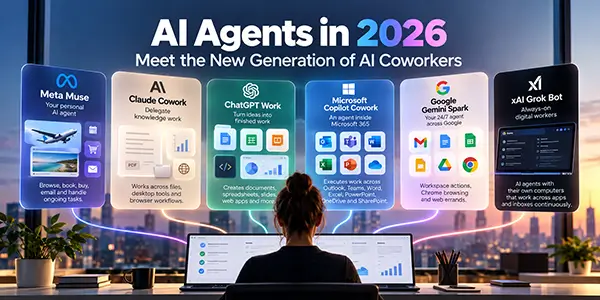
Meet the New Generation of AI Coworkers
For the past few years, generative AI has largely been about asking a question and receiving an answer.
That is starting to change.
A new generation of AI products is being designed not merely to answer questions, but to carry out work on our behalf. Instead of asking an AI to explain how to prepare a report, you can increasingly ask it to gather the information, analyse the data, build the spreadsheet, create the presentation and prepare the final report.
Instead of asking how to book a trip, an AI agent can research flights, compare options, navigate websites and begin the booking process.
And instead of manually checking an inbox every morning, an AI agent can potentially monitor it continuously, organise messages, prepare responses and escalate the ones requiring human attention.
This transition from AI chatbot to AI agent is becoming one of the most important developments in artificial intelligence in 2026.
Meta, Anthropic, OpenAI, Microsoft, Google and xAI are now approaching this new category from slightly different directions.
| AI Agent | Primary Focus | What Makes It Different |
|---|---|---|
| Meta Muse | Personal AI agent | Browsing, booking, buying, email and ongoing personal tasks |
| Claude Cowork | Delegated knowledge work | Works across files, browsers and desktop tools |
| ChatGPT Work | End-to-end professional work | Creates finished documents, spreadsheets, presentations, analyses and web apps |
| Microsoft Copilot Cowork | Microsoft 365 execution | Works directly across Outlook, Teams, Word, Excel, PowerPoint, OneDrive and SharePoint |
| Google Gemini Spark | Personal and Google ecosystem automation | Workspace integration, Chrome browsing and recurring digital tasks |
| xAI Grok Bot | Persistent digital workers | Always-on agents with their own computers that can operate across applications |
The common idea behind all six is simple:
You give the AI a goal. The AI figures out how to get the work done.
That is a significant change from the chatbot model we have become accustomed to.
What Actually Makes an AI Agent Different?
Traditional AI assistants generally operate one interaction at a time.
You ask a question.
The AI produces an answer.
You copy that answer somewhere else and continue the process yourself.
An agentic system can potentially handle much more of the workflow.
For example, imagine asking:
“Prepare our weekly management report using the latest sales figures, customer enquiries and marketing results.”
A conventional AI assistant may tell you how to structure the report.
An AI agent could potentially retrieve the information from connected systems, analyse the numbers, identify changes, create charts, assemble the report and deliver a completed document for review.
Several capabilities are converging to make this possible: persistent tasks, access to applications and files, browser control, computer use, connected business systems, scheduling and human approval mechanisms.
The result is an entirely different interaction model.
Instead of prompt → response, the model increasingly becomes:
goal → plan → actions → review → finished work.
1. Meta Muse: A Personal AI Agent for Everyday Life
Meta’s approach may be the most consumer-oriented of the group.
Introduced in September 2026, Muse is designed as a personal AI agent that can work across everyday digital activities rather than simply answering questions inside a chat window.
Muse runs inside its own dedicated cloud environment called Muse Secure VM, which includes a browser that the agent can use to navigate websites and complete tasks. Meta says Muse can send emails, book travel, fill in forms and continue working even after the user closes the application.
Muse can also handle commerce.
Meta has integrated payment capabilities that allow Muse to make purchases after receiving the appropriate approval from the user. Sensitive actions such as sending an email or completing a purchase require confirmation.
What makes Muse particularly interesting is its focus on long-term personal context.
The idea is not simply to have an AI that answers questions, but one that understands ongoing goals, remembers relevant information and proactively helps move those goals forward.
A future interaction might therefore sound less like:
“Find me restaurants in Tokyo.”
And more like:
“Plan my family trip to Tokyo next month based on our schedule, preferences and budget. Monitor flight prices and let me know when there is a good option.”
Muse represents Meta’s vision of AI becoming a persistent digital assistant embedded into everyday life.
2. Anthropic Claude Cowork: Delegating Knowledge Work
Anthropic has taken a more work-oriented approach with Claude Cowork.
Rather than primarily focusing on personal errands, Cowork is designed around the concept of handing an AI an actual piece of knowledge work.
Claude can operate directly inside selected folders and tools, use a browser when required and interact with the computer when another integration is unavailable. Users can watch the steps Claude takes and redirect the task while it is running.
For example, a user could give Claude a folder containing sales reports and ask it to:
analyse the figures, identify unusual changes, compare the results with the previous month and prepare a management presentation.
Claude can also run scheduled work. Anthropic gives the example of generating recurring reports by retrieving information from connected systems, comparing results and creating a completed presentation for review.
That moves Claude considerably beyond document summarisation.
It becomes closer to a delegated knowledge worker.
Anthropic is also gradually removing the distinction between regular Claude conversations and the separate Cowork mode. For some users, Claude now decides automatically whether a request requires a simple response or a longer-running task.
That may ultimately be where AI interfaces are heading: users will not necessarily choose between “chat” and “agent”. They will simply describe the outcome they want.
3. OpenAI ChatGPT Work: From Instructions to Finished Deliverables
OpenAI’s approach is ChatGPT Work, which focuses heavily on turning business context into completed outputs.
ChatGPT Work can gather information across applications, files and workflows and then create finished deliverables such as documents, spreadsheets, presentations, analyses and interactive web applications.
One important part of the strategy is connectivity.
ChatGPT can use plugins to connect with systems such as email, calendars, Microsoft Teams, Slack, Google Drive, SharePoint, CRMs, project management platforms and other business applications. It can then combine information from those systems when completing a task.
For example, a sales manager could potentially request:
“Prepare an account review for tomorrow’s meeting. Use our CRM history, recent emails, meeting notes and the customer’s latest support issues. Create a presentation with the key opportunities and outstanding actions.”
The important difference is the final instruction:
Create the presentation.
The user is not merely asking ChatGPT to recommend what should be included in the presentation. The objective is for the AI to assemble the actual deliverable.
ChatGPT Work also extends the concept beyond traditional office files.
OpenAI’s Sites capability can create interactive websites and web applications such as dashboards, project trackers, launch calendars, prototypes and interactive reports.
This illustrates an important direction for AI agents.
The output of an AI interaction may increasingly be an actual working asset, rather than another piece of generated text.
4. Microsoft Copilot Cowork: An Agent Inside Microsoft 365
Microsoft has perhaps the clearest advantage when an organisation already operates heavily inside Microsoft 365.
Microsoft Copilot Cowork can take actions across the Microsoft ecosystem.
According to Microsoft, Cowork can draft and send emails through Outlook, schedule meetings, create Word documents, Excel spreadsheets, PowerPoint presentations and PDFs, post messages in Teams, search organisational information and manage files stored in OneDrive and SharePoint.
It can also run scheduled prompts so that recurring tasks happen automatically.
For businesses already storing much of their operational information inside Microsoft 365, this creates an interesting possibility.
Instead of employees moving information manually between Outlook, Teams, Excel, Word and SharePoint, an AI agent can potentially coordinate parts of that workflow.
Consider a common quotation process.
An incoming customer email arrives in Outlook. The agent identifies that it is a quotation request, extracts the relevant information, checks an Excel pricing file, prepares a quotation document, saves it to the appropriate SharePoint folder and drafts the customer response.
The employee remains responsible for reviewing or approving important actions, but much of the repetitive movement between applications can potentially be automated.
Microsoft says Copilot Cowork is already generally available for eligible work and school accounts, while the personal-account version remains in preview.
For organisations built around Microsoft 365, the attraction is obvious: the AI agent is being placed directly inside the applications where employees already work.
5. Google Gemini Spark: A 24/7 Agent Across Workspace and the Web
Google’s answer is Gemini Spark, which it describes as a 24/7 personal AI agent.
Spark is designed to continue working in Google’s cloud even when the user’s laptop is closed.
It integrates with Google’s ecosystem, including applications such as Gmail, Docs and Sheets, while newer versions can also work with local desktop files and third-party services through connected applications and MCP integrations.
Google is also bringing agentic capabilities directly into Chrome.
With permission, Gemini Spark can use logged-in websites to handle web errands such as researching travel options or scheduling appointments. Google says sensitive actions such as payments are handed back to the user for confirmation.
Spark can also monitor information continuously.
A user could ask it to follow a topic, monitor selected information or run scheduled tasks instead of repeatedly checking for updates manually.
This combination of Workspace, Chrome, search and Google’s wider ecosystem could make Spark particularly significant.
Google already sits at the centre of email, documents, browsers, search, mobile devices and cloud services for hundreds of millions of users.
Adding a persistent AI agent across those surfaces could turn Gemini from something users consult occasionally into something that continuously works on their behalf.
6. xAI Grok Bot: Always-On Digital Employees
xAI is approaching agents from a slightly different angle with Grok Bot.
Rather than presenting one assistant that handles multiple requests, xAI describes Grok Bot as a team of always-on AI agents.
Each Bot effectively receives its own computer.
According to xAI, these agents can sign into the tools organisations already use, operate across applications and inboxes, and continue working around the clock. They are designed to complete jobs end to end and return to the user when approval is required.
That creates an interesting organisational model.
Instead of having one general AI assistant, a company might eventually maintain multiple specialised agents.
One might handle sales prospecting.
Another could monitor customer enquiries.
Another might prepare marketing campaigns.
Another could perform operational administration.
Another might handle development or engineering tasks.
xAI says Grok Bot was used internally for activities including sales outreach, marketing campaigns, office operations and software bug fixes before being released externally. The product remains in beta.
This concept begins to resemble something beyond software automation.
It starts to look like a digital workforce.
The Bigger Change: Software Is Beginning to Do the Work
For decades, business software has followed roughly the same model.
Humans operate the software.
Employees open Outlook, search SharePoint, update Excel, copy information into Word, log into the CRM and move data between different systems.
Artificial intelligence is beginning to change that relationship.
Instead of employees operating every piece of software directly, an AI agent can increasingly become the layer that operates software on their behalf.
That could fundamentally change how organisations think about productivity.
The question may gradually move from:
“Which applications should our employees use?”
to:
“Which tasks should employees perform themselves, and which should they delegate to AI agents?”
That does not mean every business process should become autonomous.
The more capable agents become, the more important governance becomes as well.
Organisations evaluating AI agents should pay particular attention to five areas:
- Permissions — What information can the agent access, and what actions can it perform?
- Approvals — Which actions can happen automatically, and which require human confirmation?
- Auditability — Can the organisation see what the agent accessed, changed or sent?
- Integration — Can the agent securely connect to the systems where the organisation’s real work takes place?
- Output quality — Can it produce something employees can genuinely use, rather than simply generating another draft that requires substantial manual work?
The strongest AI agent may therefore not necessarily be the one with the most impressive model benchmark.
For businesses, the more important question may be:
How reliably can it complete a real workflow using our applications, our information and our organisational controls?
From AI Assistant to AI Coworker
Meta Muse, Claude Cowork, ChatGPT Work, Microsoft Copilot Cowork, Gemini Spark and Grok Bot all approach the market differently.
Meta is pushing toward the personal agent.
Anthropic is focusing heavily on delegated knowledge work.
OpenAI is emphasising complete professional deliverables and cross-application workflows.
Microsoft is embedding the agent deeply into Microsoft 365.
Google is combining its Workspace ecosystem, Chrome and cloud infrastructure.
xAI is pushing the concept of persistent AI teammates with their own computers.
But they are all moving in roughly the same direction.
The chatbot era taught us to ask AI for help.
The agent era will increasingly teach us to delegate work to AI.
And that may prove to be a much larger change.
As these technologies mature, the most important productivity skill may no longer be knowing how to use every individual application.
It may be knowing how to define a goal clearly, give an AI agent the right context and permissions, and review the work it produces.
In other words, the next generation of knowledge workers may spend less time operating software themselves — and more time managing the AI agents that operate it for them.

