

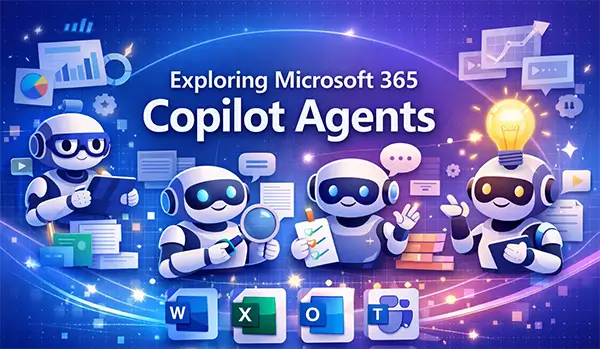
Microsoft 365 Copilot brings AI into the apps people already live in—Word, Excel, Outlook, Teams, and more—and anchors the experience around Microsoft 365 Copilot Chat, where you can ask questions in natural language and get work done faster. One of the biggest productivity upgrades inside Copilot Chat is prebuilt Copilot agents: specialized helpers you can use immediately (no setup, no training) for common work patterns like research, analysis, writing, and ideation.
This post is a practical, “what to use when” guide to the key prebuilt agents covered in Microsoft Learn’s module on the topic—Analyst, Researcher, Prompt Coach, Idea Coach, and Writing Coach—with real examples, prompt packs, and the limitations you should keep in mind.
What are Microsoft 365 Copilot Agents, really?
Think of Copilot Chat as the interface, and agents as the specialists you call in when you want deeper capability in a specific lane.
- Prebuilt agents are ready out of the box inside Copilot Chat and are designed for task-oriented help (analysis, research, writing support, prompt improvement, etc.).
- These agents work across the Microsoft 365 content you already have access to (documents, spreadsheets, Teams messages, and more), while respecting permissions and organizational boundaries.
- Microsoft also highlights that the set of available prebuilt agents can evolve over time, so what you see in your tenant may expand.
Where do you find them?
In the Microsoft 365 Copilot experience, you typically access them from the left navigation under “Agents.” If an agent isn’t pinned there, you can add it from “All agents.”
The 5 core prebuilt Microsoft 365 Copilot Agents (and when to use each)
1) Analyst: your “data scientist on demand”
If your work involves numbers, tables, survey results, performance dashboards, or “can you summarize this spreadsheet by region,” Analyst is the go-to. It’s designed to explore, interpret, summarize, and visualize structured work data using natural language prompts.
A standout capability: the module describes Analyst as performing iterative reasoning and being able to run Python for complex data queries—and letting you view what it’s doing as it works through the analysis.
Best for
- Trend and variance analysis (sales, churn, ops metrics)
- Quick summaries you can paste into reports
- Chart generation and “what-if” style questioning
Prompt pack (steal these)
- “Summarize the key trends in this dataset and call out anything unusual.”
- “Compare this quarter vs last quarter and explain the biggest drivers.”
- “Create a chart of monthly results by region and highlight the outliers.”
- “Which segments improved the most, and what changed?”
- “Based on the trend, what might next quarter look like if conditions stay similar?”
Limitations to respect
Analyst works best when your data is well structured (tables/spreadsheets). It’s not a replacement for domain expertise, and for high-stakes decisions you still want human review. It can also be less effective with unstructured data unless you first convert it into something tabular.
2) Researcher: your “strategy & synthesis engine”
Researcher is built for multi-step research and for pulling together coherent, well-structured outputs from a mix of your Microsoft 365 work context and (where enabled) broader sources. It’s positioned as a way to go from “I need to understand this topic fast” to “here’s a usable brief / strategy / report.”
Researcher is especially valuable when your real task is not “find one fact,” but “make sense of a messy space”:
- market/competitive scans
- executive summaries
- proposal background
- pulling themes across internal docs and recent activity
It can also be enhanced by connectors (for example, pulling in relevant external systems when your org enables them).
Best for
- Building a briefing from scattered material
- Competitive analysis & go-to-market scaffolding
- Summarizing long documents into decision-ready bullets
- “Catch me up on everything about Project X”
Prompt pack
- “Create an executive brief on [topic] using my recent files and cite sources.”
- “Summarize the last 90 days of discussions and key decisions for [project].”
- “Compare competitor A vs B on positioning, pricing signals, and key risks.”
- “Turn these notes into a one-slide narrative with the 3 most important takeaways.”
- “What are the top risks before entering [region], and what mitigations are realistic?”
Limitations to respect
Researcher doesn’t replace subject matter experts; access varies depending on what your org allows and what sources are integrated; vague prompts can produce broad results; and it can only use content you’re permitted to see.
3) Prompt Coach: your “prompt editor and mentor”
Prompt Coach is the agent you use when you’re thinking: “Copilot isn’t getting what I mean” or “I want a better prompt pattern for this type of task.” It focuses on rewriting unclear prompts, teaching prompt patterns, and troubleshooting why an instruction underperformed.
This is underrated: Prompt Coach helps teams standardize prompt quality fast—especially useful when rolling Copilot out to a wider org where prompt maturity varies.
Best for
- Turning vague asks into actionable instructions
- Building reusable prompt templates for your team
- Diagnosing why Copilot output missed the mark
Prompt pack
- “Rewrite this prompt to be clearer and more specific: [paste].”
- “Give me 3 alternative prompt styles to get a more structured answer.”
- “Why might this prompt produce shallow results, and how do I fix it?”
- “Create a reusable prompt template for meeting summaries.”
- “Suggest a prompt to analyze this Excel file for trend + anomaly + forecast.”
Limitations to respect
Prompt Coach improves prompts but doesn’t execute them—you’ll still run the refined prompt with another agent (like Analyst or Researcher). It also doesn’t fact-check your content; it optimizes for clarity and actionability.
4) Idea Coach: your “thinking partner”
When you’re shaping a proposal, stress-testing a plan, or refining messaging, Idea Coach behaves like a constructive sounding board. It’s designed to help you iterate: clarify your thinking, challenge assumptions, explore alternatives, and strengthen the final version before you share it.
Best for
- Pre-flight checks on proposals and plans
- Exploring options and tradeoffs
- Improving framing for leadership or non-technical audiences
Prompt pack
- “Here’s my idea—what are the strengths, weaknesses, and blind spots?”
- “Challenge this plan: what objections will come up, and how do I respond?”
- “Run a quick SWOT on this proposal based on what I’ve described.”
- “Give me 3 alternative approaches that achieve the same outcome.”
- “Rewrite the positioning so it resonates with senior leadership.”
Limitations to respect
Idea Coach is not a decision-maker, doesn’t automatically know your culture/audience specifics, and it’s not focused on fact validation—use Researcher or Analyst for validation work.
5) Writing Coach: your “professional editor”
Writing Coach helps you improve clarity, tone, structure, flow, consistency, and grammar across professional content—emails, reports, proposals, drafts—while preserving your intent.
Best for
- Polishing drafts into stakeholder-ready deliverables
- Rewriting for a different tone (firm, friendly, executive, persuasive)
- Fixing flow and transitions in longer documents
Prompt pack
- “Rewrite this email to be more professional but still warm.”
- “Improve the structure and flow; add better transitions between sections.”
- “Make this message more persuasive without sounding salesy.”
- “Check consistency in formatting, punctuation, and tone.”
- “Adapt this for an executive audience in 150–200 words.”
Limitations to respect
Writing Coach is described as refining and polishing, not replacing subject-matter verification—so you should still validate facts, especially in technical or high-stakes contexts.
Which Microsoft 365 Copilot Agent Should You Use? (Quick Decision Guide)
For SMEs, the value of Copilot Agents comes from using the right agent for the right task, not from using all of them at once.
Practical decision table
| Business Need | Recommended Agent | Why It Works |
|---|---|---|
| Reviewing sales, finance, or ops numbers | Analyst | Designed for structured data, trends, and comparisons |
| Preparing management or investor updates | Researcher | Synthesizes documents, emails, and files into briefs |
| Copilot responses feel vague or inaccurate | Prompt Coach | Improves prompt clarity and output quality |
| Evaluating business ideas or strategies | Idea Coach | Challenges assumptions and improves reasoning |
| Polishing emails, proposals, or reports | Writing Coach | Improves tone, clarity, and structure |
Role-Based SME Use Cases (Realistic Scenarios)
SME Owner / Director
- Monthly performance summary using Analyst
- Strategy review and risk analysis using Idea Coach
- Executive updates drafted and refined using Writing Coach
Finance / Operations
- Expense and revenue trend analysis via Analyst
- Operational summaries from spreadsheets and reports
Sales & Marketing
- Proposal and pitch refinement via Writing Coach
- Market or competitor summaries via Researcher
Admin / Office Management
- Meeting summaries and action items via Researcher
- Standardised prompt usage via Prompt Coach
A practical workflow: chaining Microsoft 365 Copilot Agents for real outcomes
A simple way to get outsized value is to stop thinking “which agent is best?” and start thinking “which sequence gets me to a finished artifact fastest?”
Here’s a high-leverage chain:
- Prompt Coach – refine your instruction into a crisp, high-signal prompt (clear output format, constraints, audience).
- Researcher – gather background, summarize internal context, build a structured brief with citations.
- Analyst – validate the quantitative side: trends, breakdowns, anomalies, charts.
- Idea Coach – pressure test the strategy and improve framing.
- Writing Coach – turn it into a polished memo, email, or presentation narrative.
This sequence is how you go from “I have scattered info” to “I have a decision-ready deliverable” without getting stuck in loops.
Hands-on: exercises you can run today
Exercise A: analyze a real dataset with Analyst
Microsoft Learn’s lab walks through analyzing a survey spreadsheet (“Project Nexus”) by uploading the file to Analyst and asking for top trends, averages by category, and visual comparisons. It also includes a very practical note: if you see a weird “blank space” in results, scrolling may reveal the response (and the issue may be fixed in newer builds).
Even if you don’t use their exact dataset, the pattern is gold:
- start with a top trends question
- ask for category averages
- request a visual comparison
- ask for anomalies + recommendations
Exercise B: synthesize your last 90 days of work with Researcher
Another lab suggests picking a real project from your last 90 days and asking Researcher to summarize discussions, documents, and emails; then iterating with follow-ups like action items, decisions, blockers, or a draft status update.
Exercise C: pick a different agent and solve a real problem
A third lab is open-ended: choose an agent other than Analyst or Researcher, test the sample prompts, run several project-relevant queries, and produce a concrete output (follow-up plan, status update, summary report, action plan).
Admin + rollout notes: licensing and availability in the real world
A practical rollout question is: “Do users need anything special to use agents?”
- Microsoft Learn notes that agents are included for Microsoft 365 Copilot–licensed users (no extra enablement needed for that scenario).
- Microsoft’s licensing documentation explains that Microsoft 365 Copilot is an add-on that requires an eligible Microsoft 365 plan (Business, Enterprise, etc.), and it distinguishes web-based vs work-based Copilot Chat experiences.
- Microsoft Support documentation also points users to where agents appear in the UI (Agents → All agents) and how to add them.
If you’re rolling this out inside an org, the biggest adoption unlock usually isn’t “turn it on,” it’s:
- teaching users which agent to use when
- giving them prompt templates by role (sales, finance, HR, ops)
- setting expectations around permissions, data boundaries, and human review
Microsoft 365 Copilot Agents Common pitfalls (and how to avoid them)
Pitfall 1: Asking Analyst to interpret messy, unstructured data
Fix: clean it into tables first, or use Researcher to summarize text into a structured outline, then analyze.
Pitfall 2: Vague prompts with Researcher
Fix: specify timeframe, region, audience, output format (“1-page brief”, “bullet list”, “talking points”), and what sources to include.
Pitfall 3: Treating Writing Coach as a fact checker
Fix: use it to polish, but validate technical accuracy separately.
Pitfall 4: Forgetting Prompt Coach exists
Fix: when output misses the mark, don’t re-run blindly—use Prompt Coach to reshape the instruction, then execute with the right specialist agent.
A simple “prompt format” that works across all agents
When in doubt, use this structure:
- Goal: what you want
- Context: which files, timeframe, audience
- Output: format (table, bullets, email draft, slide outline)
- Constraints: tone, length, assumptions, must-include items
- Next step: ask for 2–3 follow-up questions if needed
Then, if it still underperforms, drop the prompt into Prompt Coach and ask it to rewrite for clarity and specificity.
What Microsoft 365 Copilot Agents Are NOT
Copilot Agents do not:
- Make final business decisions
- Replace accountability or approval
- Validate legal, financial, or regulatory accuracy
- Access data users are not permitted to see
They do:
- Speed up analysis and drafting
- Reduce repetitive work
- Improve clarity and consistency
Microsoft 365 Copilot Agents Security, Privacy, and Data Boundaries (Plain English)
- Copilot Agents respect Microsoft 365 permissions
- Users can only access files they already have access to
- No cross-tenant data leakage
- No visibility into data outside your organisation
- Human review is still required before sharing outputs externally
Microsoft 365 Copilot Agents Wrap-up
Prebuilt Microsoft 365 Copilot agents are best thought of as a toolbelt:
- Analyst turns structured data into insights and visuals.
- Researcher synthesizes multi-step research into structured, citeable outputs.
- Prompt Coach upgrades how you ask for help.
- Idea Coach strengthens your thinking before you ship it.
- Writing Coach polishes communication into professional-grade drafts.
Used together, they reduce busywork and shorten the distance between “raw inputs” and “finished deliverables”—without requiring users to become prompt engineers.
Helpful “agents” references (for rollout + adoption context)
https://support.microsoft.com/en-us/topic/agents-built-by-microsoft-9cc7cccf-b1ed-4b17-b416-2c15e5e13d5a
https://learn.microsoft.com/en-us/copilot/agents
https://learn.microsoft.com/en-us/copilot/microsoft-365/microsoft-365-copilot-licensing
https://www.microsoft.com/en-us/microsoft-365/blog/2025/03/25/introducing-researcher-and-analyst-in-microsoft-365-copilot/

